Mastering Space with a Laser Cut Wall Organizer SVG File
In the modern era of digital fabrication, the intersection of design and utility has never been more accessible. For creators, small business owners, and DIY enthusiasts, the ability to transform raw materials into functional art is a game-changer. At the heart of this transformation lies the Laser Cut Wall Organizer SVG File, a digital asset that serves as the blueprint for creating sleek, custom storage solutions. Whether you are utilizing a Glowforge, an xTool, or any other CO2 or diode laser cutter, these files open the door to a world where clutter is replaced by style and precision.
The concept of a wall organizer is not new, but the method of creating one has evolved dramatically. Traditionally, building a shelf or a rack required woodworking skills, power tools, and significant time. Today, with the right Laser Cut Wall Organizer SVG File, the process is streamlined. You simply load the file, select your material, and let the machine do the heavy lifting. This shift allows individuals to focus on the creative aspects of finishing and assembly rather than the laborious task of cutting and measuring.
The Anatomy of a Perfect Digital Template
When evaluating a Laser Cut Wall Organizer SVG File, it is essential to understand what makes a template effective. A high-quality file is not just a collection of lines; it is a carefully engineered set of instructions designed for specific material properties. The most robust files account for kerf—the width of the material removed by the laser beam—ensuring that joints fit together snugly without being too tight or too loose.
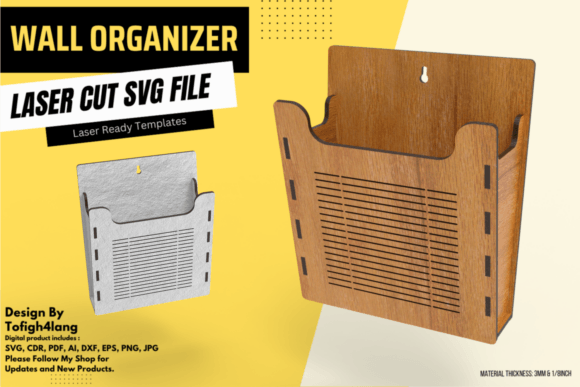
These templates are typically designed for materials with a thickness of 3mm or 1/8 inch. This specific thickness is the industry standard for plywood, acrylic, and MDF used in laser crafting. It offers the perfect balance between structural integrity and aesthetic delicacy. A wall organizer built from 3mm material is sturdy enough to hold keys, mail, sunglasses, and small office supplies, yet thin enough to maintain a minimalist profile on your wall.
Versatility in file formats is another critical characteristic. A comprehensive package will include SVG, CDR, PDF, AI, DXF, EPS, PNG, and JPG formats. Why so many? Different software ecosystems prefer different inputs. Vector formats like SVG, DXF, and AI are essential for the actual cutting process because they define paths rather than pixels. Raster formats like PNG and JPG are invaluable for previewing the design, creating marketing materials, or using as a reference guide during assembly. Having access to all these formats ensures that regardless of whether you use Adobe Illustrator, CorelDRAW, LightBurn, or Inkscape, you can proceed with your project immediately.
Real-World Applications and Scenarios
The utility of a Laser Cut Wall Organizer extends far beyond a single room or purpose. Its adaptability makes it a valuable tool for various environments:
- Home Entryways: Imagine walking into a home where keys, wallets, and leashes have a designated spot. A laser-cut organizer mounted near the door eliminates the daily "where did I put my keys?" panic. The geometric designs often available in these SVG files add a touch of modern decor to functional storage.
- Home Offices: With the rise of remote work, desk space is at a premium. A wall-mounted organizer can hold pens, sticky notes, and USB drives, keeping the desktop clear for laptops and monitors. The precision of laser cutting allows for intricate compartments that traditional carpentry might struggle to replicate efficiently.
- Retail and Cafes: Small business owners can use these organizers to display merchandise or organize order slips. Because the designs are digital, they can be easily scaled or modified to fit brand colors and specific spatial requirements.
- Educational Settings: Teachers can use these files to create classroom management tools, such as pockets for student names or holders for learning aids. It is an excellent way to introduce students to the concepts of design and engineering.
From Download to Deployment: A Practical Guide
Acquiring a Laser Cut Wall Organizer SVG File is only the first step. To truly benefit from this digital asset, one must understand the workflow from file to finished product. Here is a practical approach to ensuring success:
- File Inspection: Before sending anything to the laser, open the file in your preferred vector software. Check for open paths or overlapping lines that could cause cutting errors. Ensure the dimensions match your intended final size.
- Material Selection: While 3mm plywood is the standard, do not feel limited. Birch plywood offers a clean, light finish, while walnut provides a rich, dark contrast. Acrylic can create a modern, translucent look. Always test your settings on a scrap piece of the same material to determine the correct power and speed.
- Cutting and Cleaning: Once the laser has done its work, remove the pieces carefully. Sand any edges if necessary, especially if using wood, to remove char marks and ensure a smooth touch. This step significantly elevates the perceived quality of the final product.
- Assembly: Most well-designed SVG files utilize interlocking tabs (finger joints) that require no glue, though a dab of wood glue can add permanence. Assemble the organizer on a flat surface to ensure it sits flush against the wall later.
- Mounting: Consider how the organizer will attach to the wall. Some designs include integrated hanging slots, while others may require hidden brackets or French cleats for a floating effect.
Commercial Viability and Creative Freedom
For entrepreneurs and makers, the Laser Cut Wall Organizer SVG File represents more than just a personal project; it is a potential revenue stream. The ability to produce handmade items quickly and consistently is a significant advantage in the marketplace. Because the design work is already done, the creator can focus on production efficiency, finishing techniques, and marketing.
Selling handmade items created from these files allows for customization that mass-produced goods cannot match. You can offer personalized engraving, choose unique wood stains, or bundle organizers with other matching decor items. However, it is crucial to review the licensing terms of the specific file you purchase. Many designers allow for commercial use, enabling you to sell physical products made from their designs, but restrictions on reselling the digital file itself are standard.
Considerations and Limitations
While the benefits are numerous, it is important to maintain realistic expectations. A laser cutter is a powerful tool, but it has limitations. The Laser Cut Wall Organizer SVG File is designed for flat sheet materials. If you intend to hold very heavy items, you must ensure the wall mounting method is robust enough to support the weight, as the 3mm material itself has limits. Additionally, the complexity of the design can affect cutting time. Intricate patterns look stunning but will consume more machine time and energy than simpler geometric shapes.
Furthermore, the quality of the final output is heavily dependent on the calibration of your machine. A file that works perfectly on a 60-watt CO2 laser might require adjusted settings on a 5-watt diode laser. Users must be prepared to tweak speed and power settings to achieve clean cuts without burning the material.
Conclusion: Elevating Organization Through Technology
The Laser Cut Wall Organizer SVG File is a testament to how digital tools can enhance our physical spaces. It bridges the gap between abstract design and tangible utility, offering a solution that is both aesthetically pleasing and highly functional. Whether you are a hobbyist looking to tidy up your workspace or a professional seeking to expand your product line, these files provide a solid foundation for creativity.
By understanding the nuances of material thickness, file formats, and assembly techniques, you can unlock the full potential of your laser cutter. The result is not just an organizer; it is a statement piece that reflects a commitment to order, style, and innovation. As the community of makers continues to grow, sharing knowledge and refining designs, the possibilities for what can be created with a simple SVG file are limitless. Keep exploring, keep creating, and stay tuned for updates and new products that continue to push the boundaries of what is possible in the world of laser cutting.