Integrating Steampunk Heart Layered Cut Out Wall Art into Professional and Creative Workflows
The intersection of digital design and physical fabrication has created a dynamic landscape for creators, small business owners, and hobbyists alike. Within this space, specific assets serve as critical building blocks for larger projects. One such asset is the Steampunk Heart Layered Cut out Wall Art. This is not merely a decorative image; it is a functional component designed for precision manufacturing via laser cutters, CNC routers, and craft machines. Understanding how to integrate this digital download into a broader production workflow allows professionals to maximize efficiency, maintain quality control, and deliver high-value finished products.
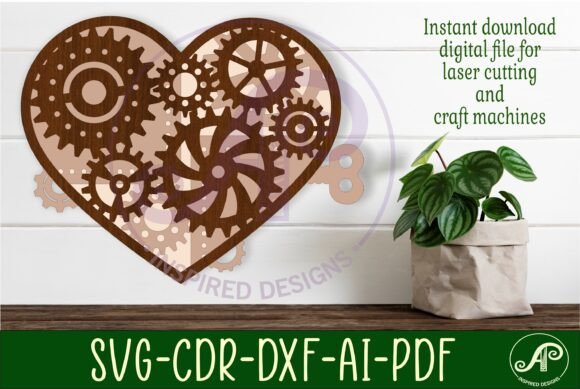
At its core, this asset represents a pre-engineered solution for layered fabrication. The design features a complex steampunk aesthetic—characterized by gears, cogs, and industrial motifs—arranged within the universal symbol of a heart. What distinguishes this file from standard clip art is its structural preparation for multi-material assembly. It is formatted specifically for machines that remove material or cut through layers, ensuring that the final physical object possesses depth and texture that flat printing cannot achieve. For entrepreneurs and freelancers, recognizing the utility of such files is the first step in streamlining the transition from concept to tangible inventory.
Pre-Production Planning and File Compatibility
Successful implementation begins long before the machine is powered on. The preparation phase involves selecting the right digital assets and ensuring they align with your hardware capabilities. The Steampunk Heart Layered Cut out Wall Art package typically includes a variety of vector formats, such as SVG, DXF, AI, CDR, and PDF. This diversity is crucial for workflow compatibility.
- SVG (Scalable Vector Graphics): Ideal for web-based laser software and modern craft cutters like Silhouette or Cricut. These files often come with color-coded layers (e.g., exterior cut lines in blue) to distinguish between cutting paths and engraving areas.
- DXF (Drawing Exchange Format): The industry standard for CAD software and many industrial CNC routers. If your workflow relies on AutoCAD or similar engineering tools, this format ensures geometric precision without data loss.
- AI and CDR: Native formats for Adobe Illustrator and CorelDRAW respectively. These are essential for designers who need to modify the vector nodes, adjust gear spacing, or integrate the heart into a larger composition before sending it to the cutter.
When incorporating this asset into a project, the first task is verification. Download the zip folder and inspect the layers. A well-organized file will have distinct paths for each layer of the heart. This organization saves significant time during the setup phase, preventing errors where a machine might attempt to cut an engraving line or miss a structural joint. For professionals managing multiple client orders, having files that are "machine-ready" reduces the risk of costly material waste.
Scaling and Adaptation for Diverse Projects
One of the primary advantages of vector-based laser cut files is scalability. The Steampunk Heart Layered Cut out Wall Art is designed to cut at approximately 25cm and 30cm wide, but because it is vector-based, it can be resized indefinitely without losing resolution. This flexibility allows the same asset to serve different market segments or project requirements.
Consider a scenario where a small business owner is preparing for a seasonal craft fair. They might produce the standard 30cm version as a premium wall hanging sold at a higher price point. Simultaneously, they could scale the design down to 10cm to create matching coasters, keychains, or ornament add-ons. This ability to repurpose a single digital purchase across multiple product lines enhances inventory diversity without requiring additional design time. It is a strategic approach to resource management, allowing creators to stretch the value of every digital acquisition.
However, scaling requires attention to material constraints. When reducing the size significantly, fine details like small gears or thin connecting bridges may become fragile or impossible to cut depending on the material thickness. Conversely, enlarging the design for a large-scale installation may require adjusting the kerf compensation (the width of the laser beam) to ensure tight joints. Practical implementation involves testing a prototype at the target size before committing to a full production run.
Material Selection and Machine Setup
The physical outcome of the Steampunk Heart Layered Cut out Wall Art depends heavily on material selection and machine calibration. This design is intended for layered construction, meaning the choice of material dictates the final aesthetic and structural integrity. Common choices include plywood, MDF, acrylic, and even leather or cardstock for lighter applications.
For a rustic, industrial look that complements the steampunk theme, birch plywood is an excellent choice. It offers strength for hanging and takes stains or paints well. If the goal is a sleek, modern interpretation, colored acrylics can provide a striking contrast between the mechanical gears and the organic heart shape. When setting up the laser cutter or CNC router, operators must configure power and speed settings specific to the chosen material thickness. Since this is a layered project, consistency is key; every layer must be cut to the exact same dimensions to ensure they stack flush.
Many laser software platforms allow users to assign different colors to different cut depths or operations. The provided files often utilize blue lines for exterior cuts, a convention that simplifies the setup process. By mapping these colors to specific machine parameters, operators can automate the sequence of operations—cutting the outer profile first, then the internal details, or vice versa, depending on what minimizes material movement and maximizes edge quality.
Assembly, Finishing, and Quality Control
Once the cutting process is complete, the workflow shifts to assembly and finishing. This stage transforms individual flat pieces into a cohesive three-dimensional object. The layered nature of the Steampunk Heart Layered Cut out Wall Art means that alignment is critical. Misaligned layers can ruin the visual depth and structural balance of the piece.
A practical assembly workflow involves dry-fitting the layers before applying adhesive. This allows the creator to check for any warping in the material or slight deviations in the cut path. Once satisfied, a strong wood glue or acrylic cement is applied. Clamping or using weights during the drying process ensures a flat, uniform bond. For professional results, sanding the edges lightly after assembly can remove any scorch marks from the laser or roughness from the CNC bit, preparing the surface for finishing.
Finishing touches are where the product gains its unique character. The steampunk aesthetic lends itself well to metallic waxes, dark stains, or dry-brushing techniques that highlight the gear details. For educators teaching design or manufacturing, this stage offers a valuable lesson in post-processing. It demonstrates that the digital file is only half the equation; the human element of assembly and finishing defines the final quality. Implementing a quality control checklist at this stage—checking for loose layers, visible glue residue, or uneven staining—ensures that the final product meets professional standards.
Strategic Applications in Business and Education
Beyond individual crafting, this type of digital asset fits seamlessly into various business and educational models. For marketers and content creators, producing time-lapse videos of the cutting and assembly process provides engaging social media content that showcases craftsmanship. For interior designers, these layered artworks offer customizable decor solutions that can be tailored to a client's specific color palette or size requirements.
In an educational setting, utilizing the Steampunk Heart Layered Cut out Wall Art serves as a comprehensive lesson in STEM (Science, Technology, Engineering, and Mathematics). Students learn about vector geometry, material properties, machine operation, and spatial reasoning as they assemble the layers. It bridges the gap between digital design theory and physical engineering reality.
Furthermore, for freelancers offering custom gift services, this asset provides a reliable base for personalization. Adding engraved names or dates to the background layers while keeping the foreground steampunk elements intact creates a bespoke product with minimal extra effort. This modularity is essential for scaling a service-based business, as it allows for customization without redesigning the entire project from scratch.
Long-Term Workflow Integration
To fully leverage the value of digital downloads like this, organization is paramount. Storing the zip folders in a structured cloud library, tagged by style, complexity, and compatible machine types, ensures quick retrieval for future projects. Over time, a creator builds a library of such assets, enabling rapid prototyping and diverse product offerings.
The Steampunk Heart Layered Cut out Wall Art exemplifies how digital resources can accelerate physical creation. By understanding its file structures, adapting it to various scales and materials, and refining the assembly process, professionals can integrate it smoothly into their workflows. Whether the goal is to produce inventory for sale, create educational tools, or execute a specific design commission, the key lies in treating the digital file as a precise instrument within a larger, well-planned operational system. This approach minimizes friction, maximizes output quality, and ultimately drives success in the competitive landscape of digital fabrication.